
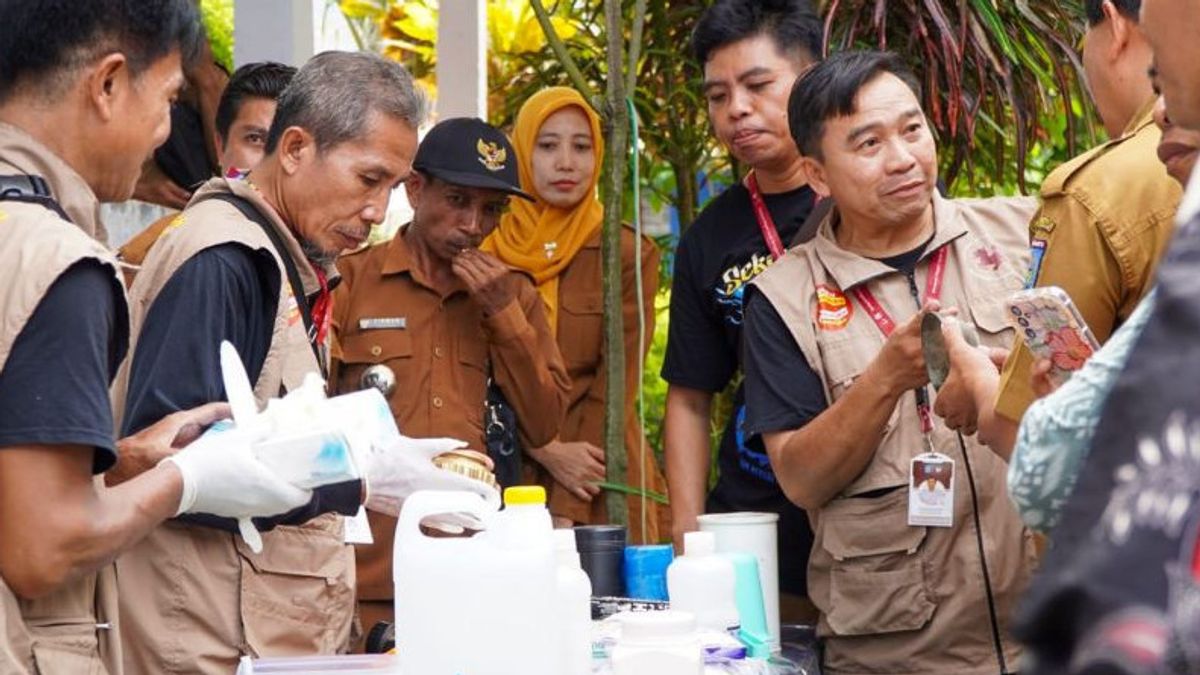
In Order To Always Lestari, The NTB Museum Teaches Residents To Care For Artifacts In The Eruption Of Mount Tambora
The West Nusa Tenggara (NTB) State Museum teaches how to care for historical royal artifacts that were lost due to the eruption of Mount Tambora to residents in Dompu Regency, local province.
"We are trying to socialize the maintenance of historical artifacts, treat these objects well, so that these objects can be maintained and preserved according to the standards we do in the museum," said NTB Museum Head Ahmad Nuralam in a statement in Mataram, Monday.
The socialization activity to care for historical and cultural heritage artifacts was carried out by the NTB Museum on 27 May 2025 in Pekat District.
Nuralam explained that Pekat District is one of the collection maintenance activities, because it is believed to be the location of an ancient kingdom that was buried by the devastating eruption of Mount Tambora in 1815.
The eruption not only rocked the archipelago, but also covered the Kingdom of Tambora, the Kingdom of Pekat, and the Kingdom of Sanggar which are on the slopes of Mount Tambora.
According to Nuralam, the eruption of Mount Tambora left traces of civilization which is still stored in the form of valuable artifacts in the local community.
The Pekat sub-district community still has various historical relics which are believed to be the legacy of the lost kingdom. The variety of artifacts is proof of past glory which is now an important part of local cultural identity.
"Local people still keep artifacts that are important historical heritage," said Nuralam.
Furthermore, he said the importance of collecting collections so that historical relics can be passed on to future generations, because artifacts depict the identity and characteristics of the local community.
Nuralam hopes that treatment efforts will not stop through one activity, but become a joint movement to save historical traces so that future generations can still know and be proud of their cultural heritage.
Pekat District is one of the largest and furthest sub-districts in Dompu Regency with an area of 95.61 square kilometers or about 40.58 percent of the total area of Dompu Regency, and about 124 kilometers from the capital Dompu.
Pekat Subdistrict consists of 12 villages and has a population of around 38,168 people who come from various ethnicities and cultures with the dominance of the Mbojo, Sasak, and Bali tribes.
Pekat Nuraini sub-district head said nearly 60 percent of the people living in Pekat sub-district were transmigrants from Lombok Island who took part in the government's transmigration program in 1970.